

Olympia Stater (91st Olympiad)
Description:
Stater Stater (91st Olympiad) coin from Olympia. Design, history & value.
Introduction
The Olympia Stater from the 91st Olympiad is a remarkable artifact of ancient numismatics, offering a glimpse into the rich history of ancient Greece. This silver coin, with its compelling imagery and historical relevance, captures the essence of the ancient Olympic Games, symbolizing both religious devotion and athletic excellence. Its intricate design and craftsmanship make it a coveted piece among collectors and historians alike.
Historical Background
The Olympia Stater was issued during the 91st Olympiad, a period that reflects the grandeur of Olympia as a cultural and religious center in ancient Greece. Olympia was not only the site of the revered Olympic Games but also a place where politics, religion, and sports intersected. This era marked a time when the Olympic Games were at their zenith, attracting spectators and participants from across the Greek world. The coin itself was minted under the authority of Olympia, serving not only as a medium of exchange but also as a commemorative piece celebrating the gods and the athletic prowess of the time.
Coin Images
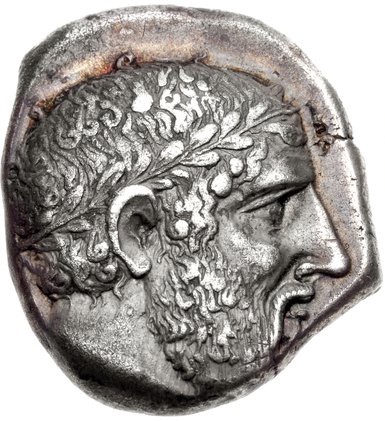 Obverse
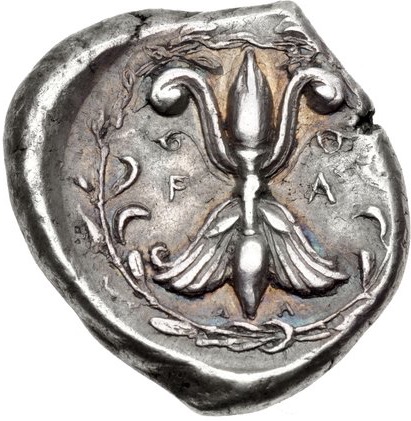 Reverse
Design Features
Obverse Design
The obverse of the Olympia Stater features a striking depiction of Zeus, the king of the Greek gods, facing right. He is adorned with a wreath of olive leaves, a symbol of peace and victory. This design pays homage to Zeus, who was believed to preside over the Olympic Games, underscoring the religious significance of the event.
Reverse Design
On the reverse side, the coin showcases a vertical thunderbolt, flanked by upper volutes and lower wings, symbolizing Zeus's power. The inscription "F-A" is elegantly placed across the central field, accompanied by a tiny "Δ-A" above the wreath ties. All these elements are enclosed within a wreath of olive leaves tied at the bottom, reinforcing the theme of victory and divine favor.
Technical Specifications
The Olympia Stater is crafted from silver, weighing approximately 12.26 grams with a diameter of 21.00 mm. Its composition and dimensions are indicative of the advanced minting techniques of the time, highlighting the skill and precision of ancient Greek artisans. The choice of silver not only reflects the coin's economic value but also its role as a prestigious item, often associated with wealth and status.
Collectible Value
As an ancient artifact, the Olympia Stater holds significant collectible value. Its rarity and historical importance make it a prized addition to any serious numismatic collection. The coin's market value is influenced by its condition, provenance, and historical context, often fetching high prices at auctions. Collectors are drawn to its unique design and the story it tells of a bygone era where the divine and the athletic were intertwined.
Conclusion
The Olympia Stater from the 91st Olympiad is more than just a coin; it is a testament to the cultural and historical legacy of ancient Greece. Its exquisite design and rich symbolism offer a window into a world where gods and athletes were celebrated in equal measure. For collectors and enthusiasts, this silver Stater represents both a tangible connection to the past and an enduring symbol of human achievement.

ScanMyCoin: AI Coin Recognition
Professional AI coin recognition and collection management platform. Identify, learn, and track your coin collection with advanced AI technology and a vast.