
Austrian Empire ½ Thaler - Francis I
Description:
½ Thaler ½ Thaler - Francis I coin from Austrian Empire. Design, history & value.
[SEO TITLE]: Austrian Empire's ½ Thaler Coin: A Collector's Gem of Francis I [SEO DESCRIPTION]: Explore the unique features of the Austrian ½ Thaler of Francis I. [KEYWORDS]: Austrian Empire, ½ Thaler, Francis I, silver coin, collectible coin, numismatics, Austrian currency
Main Content
Introduction
The ½ Thaler coin of the Austrian Empire under Francis I stands as a compelling piece of numismatic history, offering insight into the rich cultural and economic landscape of early 19th-century Europe. Minted between 1811 and 1815, this silver coin not only served as a medium of exchange but also as a symbol of imperial grandeur and authority. With its exquisite design and historical significance, the ½ Thaler is a sought-after item among coin collectors and history aficionados.
Historical Background
The issuance of the ½ Thaler under Francis I coincided with a tumultuous period in European history marked by the Napoleonic Wars and significant political shifts. Francis I, initially Francis II of the Holy Roman Empire, became the first Emperor of Austria in 1804. The creation of this coin reflects the reorganization of the Austrian Empire's monetary system amidst these geopolitical changes. The ½ Thaler thus encapsulates a critical era when Austria was asserting itself as a dominant power in a rapidly evolving European landscape.
Coin Images
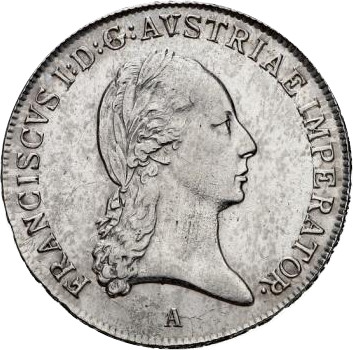 Obverse
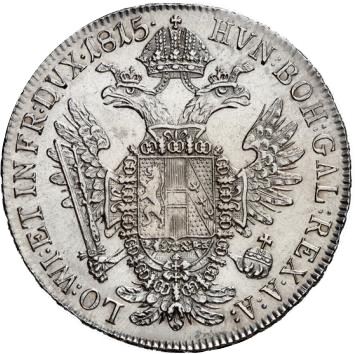 Reverse
Design Features
Obverse Design
The obverse of the ½ Thaler features a finely detailed laureate portrait of Emperor Franz II, facing right. This regal depiction encapsulates Francis I's dual role as a leader of both the Austrian Empire and the Holy Roman Empire. The legend surrounding the portrait starts at the 7 o'clock position, reinforcing the coin's official status and its association with imperial authority.
Reverse Design
On the reverse, the coin showcases the iconic crowned double-headed imperial eagle, a longstanding symbol of the Habsburg dynasty's power and influence. The eagle holds a sword and orb, denoting military might and sovereign rule. The legend begins at the 1 o'clock position, proclaiming the Emperor's titles and territorial claims, including "Hungariae Bohemiae Galiciae Rex, Archidux Austriae, Lodomeriae Wircenburgensis et in Franconiae Dux," underscoring the vast expanse of the empire's reach.
Technical Specifications
The ½ Thaler is composed of .833 fine silver, weighing in at 14.03 grams. Its diameter measures 35.00 mm, making it a substantial piece in hand. These specifications reflect the standards of the time, emphasizing durability and the intrinsic value of the silver content. Such technical attributes contribute to the coin's desirability among collectors who appreciate the tangible link to historical monetary systems.
Collectible Value
As a collectible, the ½ Thaler of Francis I commands significant interest due to its historical context and craftsmanship. Its market value varies depending on condition, rarity, and provenance, with well-preserved examples fetching a premium. The coin's allure is enhanced by its limited minting period, spanning just five years, which adds an element of rarity and exclusivity. Collectors prize this coin for its aesthetic appeal and historical resonance, often seeking it as a centerpiece for Austrian or European coin collections.
Conclusion
The ½ Thaler of the Austrian Empire under Francis I is more than just a relic of monetary history; it is a testament to the era's complex political narratives and the enduring legacy of the Habsburg dynasty. For collectors and historians alike, this coin offers a tangible connection to a pivotal period in European history. Its blend of artistry, historical significance, and intrinsic value makes it a prized addition to any numismatic collection, ensuring its status as a timeless treasure.

ScanMyCoin: AI Coin Recognition
Professional AI coin recognition and collection management platform. Identify, learn, and track your coin collection with advanced AI technology and a vast.