
Austrian Empire ½ Thaler - Francis I
Description:
½ Thaler ½ Thaler - Francis I coin from Austrian Empire. Design, history & value.
Introduction
The Austrian Empire's ½ Thaler coin, minted during the reign of Francis I from 1817 to 1824, stands as a testament to the rich history and artistry of early 19th-century European numismatics. This silver coin, with its intricate designs and historical significance, is a coveted piece among collectors and historians alike. Not only does it reflect the economic conditions of its time, but it also embodies the grandeur and authority of the Austrian Empire, making it a fascinating subject for both seasoned numismatists and those new to coin collecting.
Historical Background
The ½ Thaler of Francis I emerged during a period of significant transformation within Europe. After the Napoleonic Wars, the Austrian Empire was a dominant force in Central Europe, and its currency mirrored the empire's vast reach and influence. Francis I, the last Holy Roman Emperor and the first Emperor of Austria, issued this coin as part of his efforts to stabilize and standardize the region's currency system. Spanning the years 1817 to 1824, this coin reflects the economic and political landscape of post-Napoleonic Europe, serving as a reminder of the Austrian Empire's enduring legacy.
Coin Images
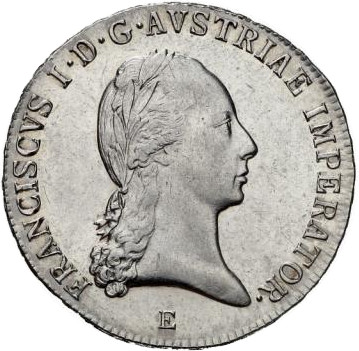 Obverse
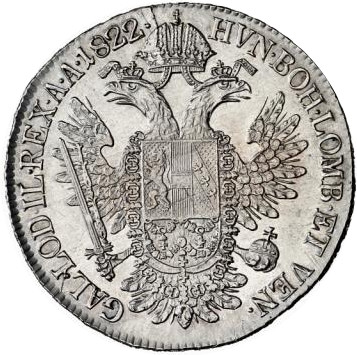 Reverse
Design Features
Obverse Design
The obverse of the ½ Thaler features a laureate portrait of Emperor Francis I facing right, a common motif in coins of this era symbolizing leadership and wisdom. The legend encircles the portrait, starting at the 7 o'clock position, providing not only a regal aesthetic but also valuable historical information about the coin's origin.
Reverse Design
On the reverse, the coin showcases a crowned double-headed imperial eagle, a powerful emblem of the Austrian Empire's strength and unity. The detailed engraving of the eagle is complemented by a legend that begins at the 1 o'clock position, listing the titles "Hungariae Bohemiae Lombardiae et Venetiae Galiciae Lodomeriae Illiriae Rex, Archidux Austriae," highlighting the emperor's extensive realm.
Technical Specifications
The ½ Thaler coin is composed of 83.3% silver, weighing 14.03 grams, and measuring 35.00 millimeters in diameter. These specifications are typical of the Thaler coins of the period, designed to facilitate international trade and commerce. The coin's substantial silver content and precise craftsmanship make it both a valuable collectible and a representative example of early 19th-century minting technology.
Collectible Value
For coin collectors, the ½ Thaler of Francis I is a prized acquisition due to its historical significance and fine artistry. The coin's value can vary based on its condition, rarity, and historical context, with well-preserved specimens fetching higher prices at auctions and numismatic gatherings. Given its limited mintage period from 1817 to 1824, the coin holds a moderate level of rarity, making it a desirable addition to any collection focused on European or imperial coinage.
Conclusion
The ½ Thaler coin of Francis I from the Austrian Empire is more than just a piece of currency; it is a historical artifact that offers insights into the economic, political, and artistic milieu of 19th-century Europe. Its detailed designs, rich silver composition, and historical importance make it a valuable collectible for anyone interested in the legacy of the Austrian Empire. Whether you are an experienced numismatist or a curious history enthusiast, this coin provides a tangible connection to a bygone era, underscoring the enduring allure of historical coin collecting.

ScanMyCoin: AI Coin Recognition
Professional AI coin recognition and collection management platform. Identify, learn, and track your coin collection with advanced AI technology and a vast.